

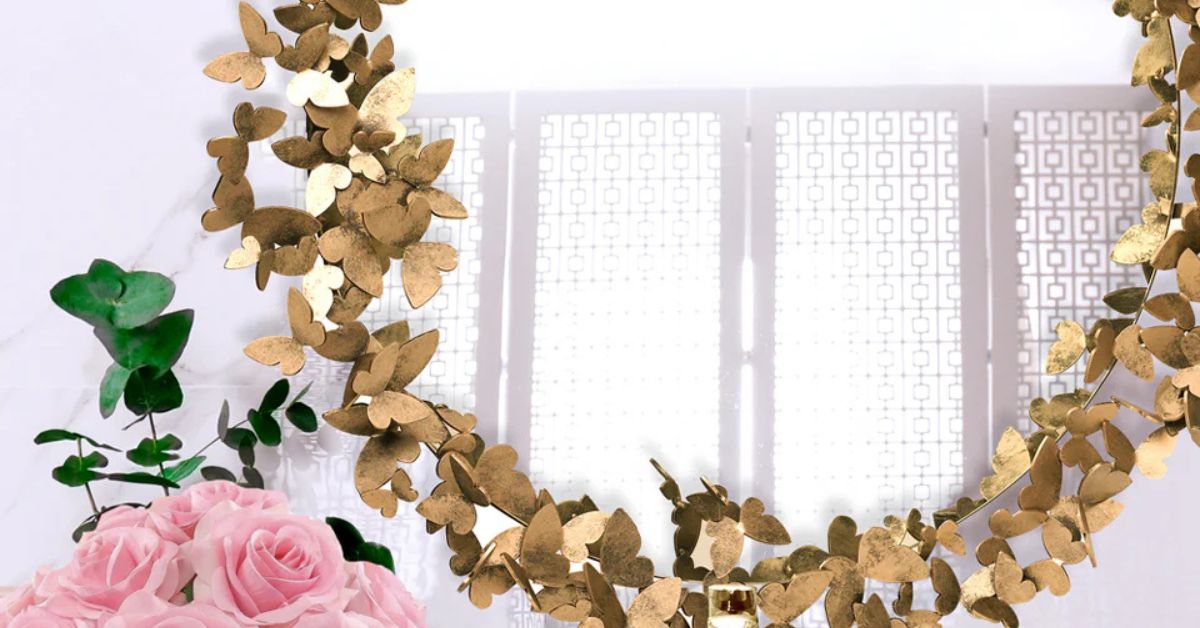
A mirror gallery wall works when several reflective surfaces read as one composition. The outside dimensions, spacing, reflected views, and relationship between frames need to be resolved before the first anchor enters the wall.
The arrangement can be quiet and ordered or loose and asymmetrical. In either case, a clear structure keeps the mirrors from feeling scattered and gives each frame enough space to register.
1. Establish the Overall Footprint
Begin with the wall, not the individual mirrors. Measure the available width and height, then account for nearby trim, switches, sconces, furniture, and circulation. The complete arrangement should relate to the architecture or the object beneath it.
Over a console, the gallery may follow the furniture's horizontal span. On an open stair wall, it may rise with the architecture. Establishing that outer boundary makes later decisions about size and spacing easier.

2. Choose an Anchor
One mirror should establish the visual weight of the composition. It may be the largest piece, the strongest silhouette, or the frame with the most movement. The remaining mirrors should support it without forming an obvious ring around it.
The anchor does not have to sit in the geometric center. An off-center position can work when the other pieces balance its scale and the complete arrangement holds together from a distance.
3. Build a Relationship Between Shapes and Finishes
A gallery wall does not require matching mirrors. It does require a reason for the pieces to sit together. Repeating one element, such as an aged finish, botanical motif, frame weight, or curved silhouette, can create continuity across different forms.
When shapes vary, keep the finish palette controlled. When finishes vary, a more consistent family of proportions can prevent the arrangement from becoming visually busy. Avoid introducing difference in every category at once.

4. Control the Negative Space
The space between mirrors is part of the design. Tighter spacing makes separate pieces read as one unit. Wider spacing gives each silhouette more independence but requires stronger alignment across the complete wall.
Measure between the outside edges of the frames, not the mirror glass. Sculptural branches, leaves, and butterflies extend beyond the reflective surface and need breathing room that a simple rectangular frame may not.
Begin with a consistent spacing interval, then adjust only where an irregular frame requires it. Equal measurements are useful, but visual balance is the final test.
5. Test the Complete Layout Before Installation
Trace the full outside dimensions of each mirror onto kraft paper. Label every template, mark its hanging point, and arrange the paper forms on the wall with painter's tape. This makes it possible to adjust the footprint without adding unnecessary holes.
Photograph the template arrangement from the room's primary entry and seating positions. The camera often reveals uneven spacing, a weak edge, or an arrangement that sits too high before installation makes those decisions difficult to change.

6. Review What Every Mirror Reflects
A gallery wall multiplies more than light. Each mirror may capture a different view, and those views change as someone moves through the room. Check for televisions, doorways, service areas, strong glare, or repeated visual clutter.
Natural light can unify the arrangement when several mirrors catch the same window from different angles. At night, sconces and lamps will create a different pattern of reflection. Review both conditions before fixing the final locations.
Plan the Installation With the Composition
Confirm the wall substrate, finished weight of each mirror, hanging hardware, and installation access. Irregular frames may have attachment points that do not align with their visual center, so each template should record the actual hardware location.
For custom work, provide the studio with a straight-on elevation, overall wall dimensions, furniture measurements, photographs, and the proposed layout. Those references help resolve scale and fabrication before installation.


