

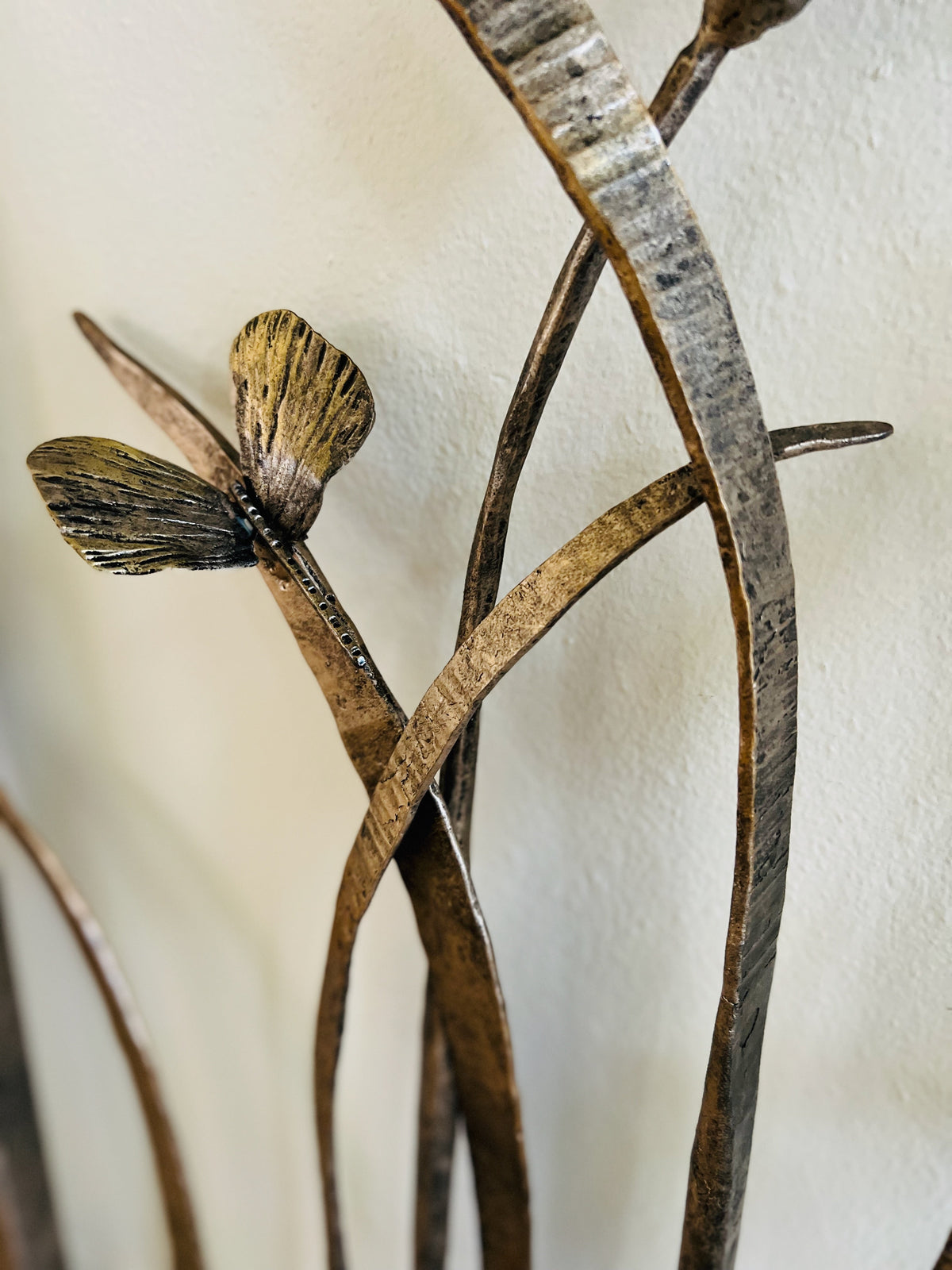
Custom metalwork begins with the room, not the object. The architecture, scale, surrounding materials, and installation conditions determine what the piece needs to do before forged iron, bronze, brass, copper, or finish enters the conversation.

For a religious and ritual space in Denver, Laura Abramson of Camellia Interior Design brought Claire Crowe Collection a concept for a gate and railing. Vega Architecture was also involved, with Alexis Petre serving as architect of record.
The studio developed a 48-inch-wide by 36-inch-high gate of hand-forged iron grasses and reeds within a stainless steel frame. Finished in African Gold, the composition includes three butterflies resting among the reeds.
The assignment was not to reproduce a landscape. It was to translate natural movement into metal at a scale and level of detail appropriate to the room. That is where custom metalwork is most useful: as a detail conceived for one project rather than decoration added at the end.

What Designers Are Commissioning
The visible result may be a fireplace screen, railing, gate panel, mirror, light fixture, or wall sculpture. Behind it are decisions about proportion, material, finish, motif, installation, and how the piece will read from the principal viewpoints in the room.
A custom metalwork studio should understand what the material can do and where restraint is needed. Metal can hold texture, shadow, and depth. It can also become too heavy, too bright, or too literal when the form is not edited carefully.
Choosing the Material
The material decision begins with the application. Does the piece need to be structural or visually light? Should it sit quietly against stone and plaster, catch light near a mirror, withstand heat at the hearth, or carry a botanical form through open space?
Forged iron is one of the studio's primary materials because it is strong and able to hold hand-worked texture. A stem can taper. A leaf can bend. A branch can turn toward a wall. The surface records forming and finishing without requiring added ornament.
Bronze, brass, and copper behave differently. Hammered bronze introduces movement across a broad surface. Brass reflects more light, which can suit lighting, mirrors, and smaller details. Copper develops tonal variation and patina when the application supports it.
Materials are not interchangeable. Heat, exposure, weight, attachment points, and the desired finish should be resolved before the drawing is approved.

Finish Is More Than Color
A hand-applied finish responds to the surface beneath it. Two pieces made from the same material and finished in the same family may still carry slight differences in tone, depth, and movement.
The studio controls that variation through samples and a defined finishing process. Natural light, nearby hardware, stone, millwork, and textiles all affect how an aged metallic tone or oxidized patina reads in the room. Review finish samples with those surrounding materials whenever possible.

Prototyping Protects the Design
A sketch establishes composition. A measured drawing establishes scale. A finish sample establishes surface. Certain details still need to be tested in metal.
The bend of a leaf, taper of a forged leg, space between reeds, thickness of a screen frame, and turn of a branch determine whether a piece feels resolved. Claire Crowe Collection designs in-house, and each piece is made one at a time by our skilled Texas artisans, who know the collection's forms and standards.

What to Provide at the Start
A complete inquiry gives the studio enough context to recommend a material, establish scope, and identify installation questions early. For designers in the specification phase, send:
- Room elevations or a measured drawing
- Overall dimensions and relevant clearances
- Straight-on and contextual photographs of the site
- Surrounding material and finish references
- Installation conditions, including attachment points, heat, moisture, or exterior exposure
- The project schedule and required delivery date
A reference image can help communicate movement, density, or proportion, but it should not ask the studio to reproduce another artist's work. The most productive references explain what the room needs rather than prescribe every fabrication decision.
How to Evaluate a Custom Metalwork Studio
Look beyond whether the shop can fabricate the object. Ask how it resolves proportion, translates a motif, manages finish variation, plans installation, and communicates what the material can and cannot do.
The finished work should feel composed for the room. In the Denver gate, that meant forged reeds with enough variation to suggest movement, enough open space to keep the panel calm, and butterflies positioned as part of the composition rather than applied decoration.


