

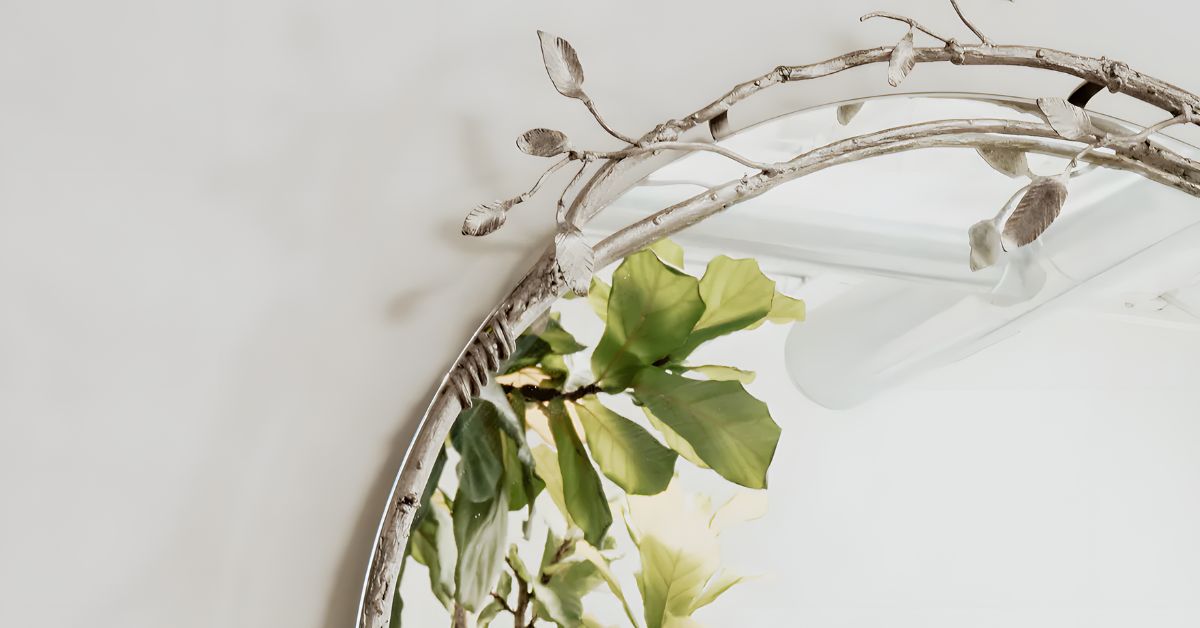
A mirror affects more than the wall where it hangs. It changes the room's sightlines, repeats light and color, and introduces another material into the composition. Most mirror mistakes begin when placement is treated as an isolated decorating decision.
For designers, the better approach is to consider the reflected view, wall proportions, installation height, frame, and surrounding furnishings together. These seven mistakes are useful checks before a mirror location is finalized.
1. Hanging the Mirror Without Reference to What Is Below It
A universal hanging height does not account for the mirror's dimensions or the furniture beneath it. A mirror over a mantel, console, or vanity should relate to that element first. The gap between them needs to feel connected without compressing the composition.
Mark the full mirror outline on the wall and review it from the room's principal entry and seating positions. This reveals whether the piece is floating too high, crowding the furniture, or interrupting nearby millwork.

2. Ignoring the Reflected View
A mirror repeats whatever sits opposite it. A garden view, window, artwork, or aligned doorway can add depth. A television, service area, or visually crowded shelf will become twice as present.
Check the reflection from several positions, not only while standing directly in front of the mirror. In a dining room or living room, the seated view may matter more than the view at installation height.
3. Choosing a Scale That Leaves the Wall Unresolved
A small mirror on a broad wall can read as an accessory rather than part of the architecture. An oversized mirror can crowd trim, sconces, or furniture and remove the breathing room its frame needs.
Begin with the available wall plane and the dimensions of the object below it. A taller proportion can reinforce ceiling height. A wider form can extend the horizontal line of a console or mantel. Scale should answer the wall, not a general rule about going larger.
Use painter's tape or a paper template to test the mirror's full outside dimensions, including the frame, before approving the size.
4. Matching the Mirror Too Literally
The frame needs to belong to the room, but it does not need to repeat every shape or finish already present. A rectangular mirror can add structure to a room with curved furniture. A botanical frame can introduce movement against quiet plaster or simple millwork.
Look for a material or formal relationship rather than an exact match. Hand-forged iron may connect to fireplace hardware or window frames. An aged metallic finish may answer lighting or cabinet hardware without duplicating it.

5. Forgetting the Mirror's Function
A decorative mirror may be specified for reflection, light, architecture, or a combination of the three. Clarify its job before choosing the piece. A dressing mirror needs a useful viewing height. A mirror intended to extend daylight needs the correct angle. A mantel mirror may primarily anchor the elevation.
When the intended function is unclear, the placement often feels arbitrary even when the mirror itself is well made.
6. Using Too Many Reflective Surfaces
Several mirrors can work when they form one clear composition. Without that structure, repeated reflections divide the room and make it difficult for the eye to settle.
If the room already includes mirrored furniture, polished metal, glass, or a large reflective surface, consider whether another mirror adds something the composition needs. One well-placed piece often does more than several smaller ones.
7. Overlooking Glass and Installation Quality
Distortion, uneven silvering, visible hardware, or an unstable attachment can undermine the entire installation. Inspect the glass from an angle as well as straight on, and confirm that the wall construction can support the finished weight.
For custom work, provide the studio with wall dimensions, substrate information, elevations, and photographs. Resolve cleats, anchors, projection, and access before fabrication so the installation method belongs to the design.

A Better Mirror Specification
The right mirror is determined by the wall, the reflected view, and the material palette around it. Confirm those conditions first. Shape, finish, and decorative detail can follow with more clarity.
When a standard proportion does not resolve the elevation, custom sizing allows the mirror to answer the architecture rather than forcing the room to accommodate the object.


